


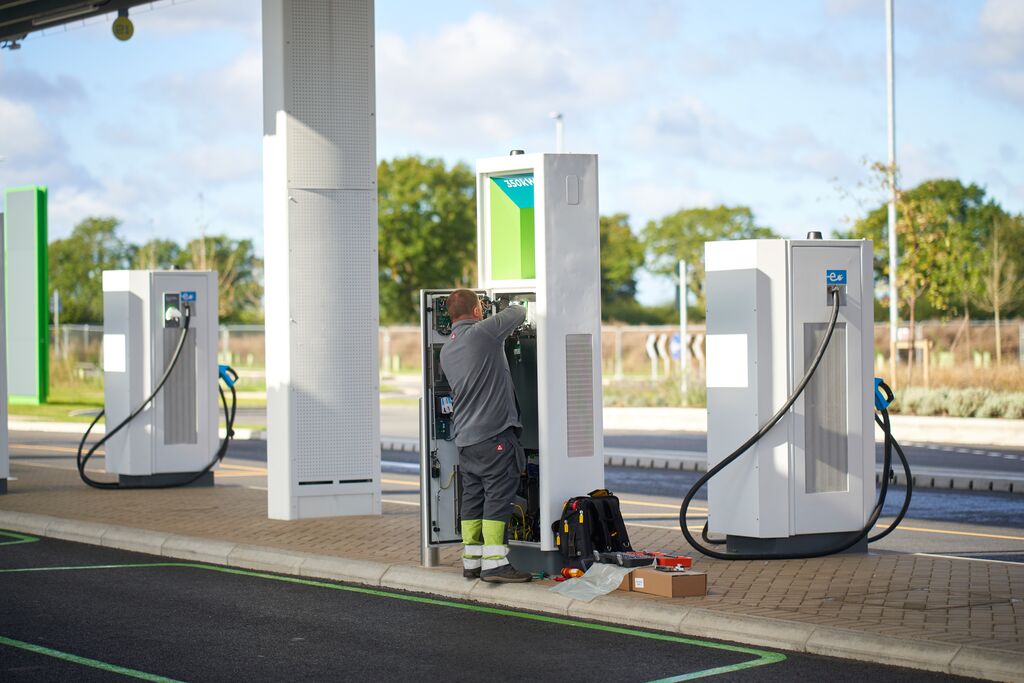
The cost of an electric car charging station depends on what kind of charger you’re installing and where it’s going. A basic home Level 2 setup can be a four-figure project, while a public DC fast-charging site can quickly move into six figures once you include electrical upgrades, trenching, and permitting.
This guide breaks down 2026 cost ranges for:
- Home Level 2 chargers
- Commercial Level 2 destination charging
- DC fast charging (DCFC) stations
- Ongoing operating costs and key factors that change the price
Charger types
Most charging projects fall into two categories:
- Level 2 (AC): common for homes, workplaces, hotels, retail. Slower than fast charging, cheaper to build.
- DC fast charging (DCFC / Level 3): highway corridors and high-turnover public sites. Much faster—and much more expensive to install.
Home EV charging station cost (Level 2) in 2026
Typical total cost (equipment + installation)
For many U.S. homes, the installation work alone often falls around $800–$3,000 (before the charger hardware), with major variation driven by the distance to the electrical panel and whether upgrades are needed.
Hardware cost: DOE’s Alternative Fuels Data Center (AFDC) notes a residential Level 2 charger can range roughly $380–$690 (charger only).
Realistic homeowner budget range
A practical all-in planning range for a typical home Level 2 install is often:
- ~$1,200–$4,000 total for many homes (charger + installation)
- More if you need a panel upgrade or long conduit/trenching
EnergySage also cites Qmerit data with an average installation cost around $2,442 (as of 2025), which is consistent with the $800–$3,000 before equipment install band.
Commercial Level 2 charging station cost (2026)
Commercial Level 2 is what you’ll see at offices, apartments, hotels, shopping centers, and fleet depots. Costs are usually discussed per port (one connector = one port).
Typical installed cost per Level 2 port
A 2026 commercial buyer’s guide from AmpUp puts typical total installed cost at about:
- $3,000–$7,000 per Level 2 port (typical)
- Higher if the site needs significant electrical work
Another 2025–2026 industry estimate suggests a broader range such as $3,000–$12,000+ per port installed, depending on power level and site complexity.
Why commercial Level 2 pricing varies
The biggest cost drivers are usually:
- Trenching/conduit distance (parking lot vs wall-mounted close to power)
- Panel capacity and electrical upgrades
- Networking/software requirements (paid managed charging platforms)
- ADA compliance and parking redesign
DC fast charging station cost (2026)
DC fast charging (DCFC) costs are higher because the equipment is larger and the electric service upgrades can be substantial.
Typical installed cost per DC fast-charging port (and per site)
AmpUp’s 2026 buyer’s guide estimates:
- $40,000–$150,000+ for DC fast charging installed (depending on site conditions and power level)
Other 2026 cost breakdowns commonly cite installed costs such as $70,000–$200,000 per port once transformer upgrades and site work are included.
It’s also common to see planning ranges like $80,000–$250,000+ per site (especially for higher-power setups and multi-stall sites).
Why DCFC is expensive
DC fast charging costs jump because you may need:
- Utility transformer upgrades / new service
- Switchgear and sometimes a new pad-mounted transformer
- Longer trenching + heavy conduit
- Larger concrete pads/bollards + safety equipment
- Higher permitting/engineering complexity
Cost summary table
| Charger type | Typical use | Typical 2026 cost range |
|---|---|---|
| Home Level 2 | Garage/driveway | Install work often $800–$3,000 before equipment; Level 2 hardware often $380–$690 |
| Commercial Level 2 (per port) | Workplace, hotel, retail | $3,000–$7,000 per port typical (can be higher) |
| DC Fast Charging (per port/site) | Public fast charging | Often $40,000–$150,000+ (many cases) and can reach $70,000–$200,000 per port with upgrades |
Operating costs you should budget for (not just installation)
Even after installation, charging stations carry ongoing costs:
Electricity + demand charges (especially for DC fast charging)
Electricity is not just a pass-through cost for DCFC. High-power stations can trigger utility demand charges and higher commercial rate structures, which can heavily influence profitability.
Software/network fees (commercial/public)
Many commercial stations require:
- Network subscription fees
- Payment processing fees
- Remote monitoring/management
Maintenance and uptime
Budget for:
- Preventive maintenance
- Repairs (connectors, screens, cables)
- Customer support and signage/stripe repainting
If you’re building a public site, uptime expectations also matter: federally funded sites must meet performance and data requirements (more on incentives below).
Incentives that can reduce charging station costs
If you’re building public fast charging on eligible corridors, the National Electric Vehicle Infrastructure (NEVI) Formula Program can fund up to 80% of eligible project costs, including acquisition and installation of chargers and network connection.
This doesn’t mean every project qualifies—but it’s an important reason many DCFC buildouts are structured around public funding.
How to estimate your real project cost (simple method)
Step 1: Choose charger type and quantity
- Example: 4 Level 2 ports at a hotel or 4 DC fast chargers at a highway site
Step 2: Estimate baseline installed cost
Use the planning ranges above:
- Commercial Level 2: start around $3k–$7k per port
- DCFC: start around $40k–$150k+ per site/port depending on scope
Step 3: Add a site complexity multiplier
Costs rise if you have:
- Long trench runs
- Limited panel capacity
- Transformer/service upgrades
- Concrete/asphalt restoration
- Strict permitting environments
Step 4: Add ongoing costs
Include network + maintenance + electricity assumptions.
FAQs
Why do EV charging station costs vary so much?
Because the charger hardware is only part of the project. Site work (trenching, electrical upgrades, transformer needs) is what usually causes wide swings—especially for DC fast charging.
Is it cheaper to install Level 2 chargers than DC fast chargers?
Yes—by a lot. Commercial Level 2 often lands in the thousands per port, while DC fast charging commonly moves into tens of thousands to hundreds of thousands depending on power and site upgrades.
What’s the most common hidden cost?
Electrical service upgrades (panel capacity, transformer upgrades) and trenching distances. These can dwarf the charger purchase price.
Conclusion
So, how much do electric car charging stations cost in 2026? In most real-world projects:
- Home Level 2: installation work often $800–$3,000 before equipment, with hardware costs often in the hundreds
- Commercial Level 2: typically $3,000–$7,000 per port installed (higher for complex sites)
- DC fast charging: commonly $40,000–$150,000+ and can reach $70,000–$200,000 per port when major upgrades are needed